On the Ground Junior: Students from Grand Traverse Academy Enhance Pollinator Habitat on Public Land
Kristina Kennedy • May 12, 2022

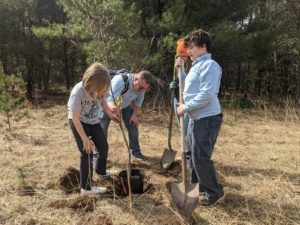
GTA students are assisted by their teacher, Mr. Lazar, in planting serviceberry bushes within their new pollinator garden in the Traverse City Forest Management Unit.

On Thursday, May 5, 2022, 37 5th and 6th grade students and 10 chaperones from Grand Traverse Academy (GTA) in Traverse City volunteered with OTG Jr and the MDNR to plant a pollinator garden and help build a deer exclosure in the Traverse City Forest Management Unit (FMU) in Union Twp. Students broadcast-planted wildflower seeds, as well as planted 24 potted plants including lupine. They also planted 24 large shrubs including serviceberry and nannyberry. These soft mast-producing shrubs are an important component of healthy wildlife habitat. Not only are the shrubs well-adapted to local growing conditions, but they also attract target pollinator species like songbirds, insects, and small mammals that may consume the fruit mast and disperse seeds into the environment.

After planting the flowers and shrubs, students helped place large posts that will anchor the fencing used to exclude deer from the garden. When plants and shrubs are initially placed into a new area, it’s a good idea to protect them using tubing or fences to keep deer and other wildlife from browsing on all of the new buds. Once the plants are well-established, the fencing may be removed and reused.
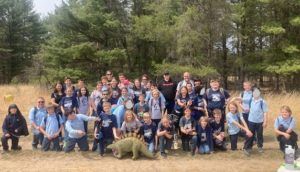
Students from GTA gather for a group photo after getting their hands dirty in their newly-planted pollinator garden on state land just outside Traverse City.

During the project, students learned about the importance of pollinators in the ecosystem and native vegetation that supports pollinator populations. After completing the habitat improvement work, students participated in guided activities including archery lessons and a predator-prey game.

In total, students directly enhanced about 1 acre of wildlife habitat, but their efforts will extend beyond this acre and continue to impact a large area of wildlife habitat on public land for years to come.

Recent Posts
By Olivia Triltsch May 7, 2026
On Saturday, May 2, 2026, a group of dedicated volunteers joined Kirtland's Warbler Alliance, Huron Pines, Saginaw Children’s Zoo, and MUCC's OTG program in planting approximately 4,800 jack pine saplings within the Grayling Forest Management Unit in Crawford County. Jack pines are a critical nesting habitat feature for the once-threatened Kirtland’s warbler. In total, volunteers directly impacted about 7 acres of land were prepared by the Michigan DNR for this planting to allow volunteers to maximize their efforts across the land. This is one of our annual events that is perfect for helpers of all ages and interests.
May 4, 2026
FOR IMMEDIATE RELEASE: Michigan United Conservation Clubs (MUCC) announces its decision to dissolve after nearly 90 years of conservation advocacy, citing ongoing financial challenges and outlining next steps in an orderly wind-down process.
By Olivia Triltsch April 30, 2026
On Saturday, April 25, 2026, MUCC's On the Ground program partnered with the Michigan Department of Natural Resources (DNR), Ruffed Grouse Society, National Wild Turkey Federation, and Backcountry Hunters and Anglers for a crabapple tree planting and dump site clean-up event in the Grayling Forest Management Unit. Volunteers worked as a team to plant, compost, mulch, and fence 25 eight-foot trees at various locations in Crawford County on the public lands to offer forage for wildlife. Many species, like grouse, turkey, and deer, utilize mast-producing trees for food when other resources are not available. These trees were planted along an old logging road for both game and non-game wildlife, while enhancing the local recreational opportunities. Another group of volunteers branched off to remove trash from three dump sites on public land in Kalkaska County, which included couches, mattresses, shingles, and tires. Volunteers filled a 30-yard dumpster with trash found in the landscape in an attempt to keep the environment better than how it was found while improving future recreational opportunities. In total, volunteers directly enhanced 2.1 acres of wildlife habitat through this project.
More Posts