OTG Event at Pierce Cedar Creek Institute Launches Prairie Restoration Effort

Two OTG wildlife volunteers work together to cut down invasive autumn olive at Pierce Cedar Creek Institute. September 2021.
On Saturday, September 11, 2021, a group of 15 volunteers gathered at Meadow Lodge of the Pierce Cedar Creek Institute (PCCI) to launch a prairie restoration effort across 4.5 acres of surrounding fields.
Located along the north and west sides of Meadow Lodge on Cloverdale Road, the fields involved in the restoration efforts were formerly used for agricultural and grazing purposes before the property was acquired by PCCI. The fields presently contain a mix of invasive woody vegetation like autumn olive and multiflora rose, nonnative grasses, and native flora like goldenrod and aster species. For this volunteer day, the invasive woody vegetation was targeted for mechanical removal and herbicide treatment.
Following an explanation of the project goals and the natural history of the property provided by MUCC and PCCI, volunteers gathered loppers, hand saws, and herbicide spray bottles to begin the first phase of a large restoration effort. The entire main field nearest to Meadow Lodge was successfully cleared of a majority of invasive woody vegetation by volunteers, and although not all of the stems and stumps were able to be treated with herbicide, future management efforts will take care of any regeneration.
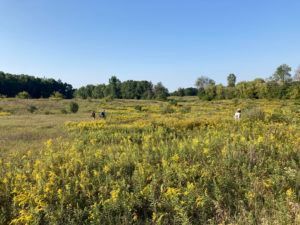
A view of the main field prior to woody vegetation removal. Looking northwest from Meadow Lodge.
In the coming fall or spring, PCCI intends to run a prescribed burn through the fields where the volunteers worked. Prescribed burns not only rid the landscape of remaining vegetation, but they enrich the soil with valuable nutrients that future vegetation can utilize to thrive. The prescribed burn will be followed by one or two rounds of herbicide treatment to rid the landscape of surviving undesirable vegetation before the seed bank is replenished with native grass and wildflower species that will restore the 4.5 acres to shortgrass prairie habitat.
We appreciate the volunteers that joined us for this event, and for PCCI for hosting the event with MUCC.
Learn more about MUCC’s award-winning On the Ground program at mucc.org/on-the-ground .
The post OTG Event at Pierce Cedar Creek Institute Launches Prairie Restoration Effort appeared first on Michigan United Conservation Clubs.
Recent Posts